


Left: COGS Home Page
Up: COGS Home Page
LECTURE 4

- Modelling aspects of language understanding
-
- Essay (May 30th)
-
- Exam (June 19th)
-
- Connectionism (cf Green et al. Chapter 2)

ESSAY
-
- ``A Cognitive Model of ...''
-
- 2000 words, counts 50%
-
- Thursday May 30th 4pm
-
- Plagiarism (see Course Outline and Exam Handbook)
EXAMINATION
Candidates must attempt TWO questions
- Using a simple neural network program that you have studied
as an example:
- Explain with an example how the network computes output values,
given input values.
- Explain how the network can be taught.
- Briefly discuss the strengths and weaknesses of the program as a model
of human performance.
- Compare and contrast Act* and Soar as explanatory tools in cognitive
science.
- Using a Production System
that you have studied as an example:
- Explain how a production system works.
- Explain the difference between Working Memory and Production Memory.
- Briefly discuss the strengths and weaknesses of Production Systems
as tools for cognitive modelling.
WORDS AND NON-WORDS
vague               gauve               ugvae
boats               batso               bstoa
smoke               kemos               ekmso
maize               zamie               imzai
CONNECTIONISM
-
- Systems produce some ``human-like'' behaviour
-
- generalize from examples: ``I goed home''
-
- cope sensibly with examples have not been trained on
-
- can be made to malfunction in ways evidenced by humans with brain
damage
-
- Non-symbolic, but still runnable cognitive models
-
- Based loosely on analogy to structure of brain
-
- Many interconnected simple processing units
-
- Overall behaviour a function of
-
- what each of the simple processing units do
-
- as well as how they mutually communicate
NEURAL NETWORKS
-
- Strongly associated with modelling learning of ``patterns'' (e.g.
discrimination tasks)
e.g. cows vs tanks, rules of pronunciation
-
- Relatively robust (contrast symbolic models)
-
- Nodes with very simple behaviours, linked by
-
- Arcs with strengths
-
- Activation flows from node to node along arcs (depending
on strengths) and depending on behaviour at each node.
-
- Neural network -- analogy to brain behaviour
-
- Many different kinds of network architecture
DISCRIMINATING WORDS FROM NON-WORDS
Enter a word with 5 letters (or RETURN to quit): offal
   The word offal scores 0.732206 in favour, and 0.264867 against

Enter a word with 5 letters (or RETURN to quit): okkly
   The word okkly scores 0.000437 in favour, and 0.999486 against
THREE LAYER FEED FORWARD NETWORKS -- 1
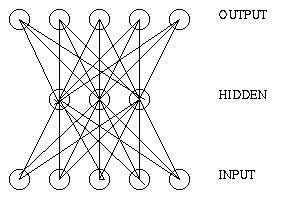
THREE LAYER FEED FORWARD NETWORKS -- 2
-
- Input Layer of nodes -- linked to input values e.g.
a word, a sentence, a picture, a pattern
-
- An intermediate or Hidden Layer of nodes via which
generalisations and discriminations computed
-
- Output Layer from which the output is taken e.g.
yes/no, transformation of word or sentence, classification of pattern or
picture.
BASIC BEHAVIOUR OF NETWORK -- 1
To determine if a node will fire
- See what arcs feed into that node
- See what nodes these arcs are linked to
- Compute

- If result greater than threshold for that node, fire it
- Propagate calculations forward from all input nodes to output nodes
CALCULATION AT NODE N
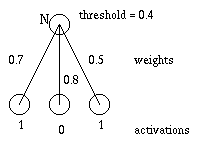

so fire node N
TEACHING THE NETWORK
- Choose number of nodes in each layer according to problem
- Assign random weights to arcs and random thresholds to nodes
- Select sample of training examples (input/output pairs)
- For each example
- Compare pattern on output layer with what it should have been
- Make small adjustments to weights and thresholds (e.g.
by back propagation) so as to make the actual output a bit closer to
the desired output
- Repeat 4 many times
Test on novel examples
DISCRIMINATING WORDS FROM NON-WORDS -- 1
-
- Assume 5 letter words
-
- Examples: hotel swiss; Non-examples: kaamt jomet
-
- Input layer:
 nodes
-
- Hidden layer: 20 nodes
-
- Output layer: 2 nodes -- ``in favour'', ``against''
DISCRIMINATING WORDS FROM NON-WORDS -- 2
Number of letters in each word (5):
Number of different real words to train on (500):
Number of random "words" to train on (500):
Number of examples to show to the net in training (2000):
Number of units in the net's hidden layer (20):
Initial weight range for net (0.5):
Learning rate constant for net (0.5):
Momentum constant for net (0.9):
DISCRIMINATING WORDS FROM NON-WORDS -- 3
The first 40 training words, marked as + or - examples, were:
agony+ offal+ tkqbr- whmvt- asher+ kaamt- gngpu- ttqmc- faber+ wstki-
akyli- cprqq- swiss+ estes+ midge+ exact+ blair+ zqpgp- xmefi- acton+
arena+ drown+ supra+ eppis- linen+ chirp+ sjfhv- xplou- axial+ rlsut-
krnnc- wylie+ hotel+ bineb- cohen+ kwgwc- ndbry- bobby+ jomet- dwypv-

Enter a word with 5 letters (or RETURN to quit): offal
   The word offal scores 0.732206 in favour, and 0.264867 against

Enter a word with 5 letters (or RETURN to quit): okkly
   The word okkly scores 0.000437 in favour, and 0.999486 against
REPRESENTATION ISSUES
-
- Representation distributed throughout weights and thresholds
-
- Can make decent guess for examples not been trained on
-
- Experiments with other systems have shown that ``damaged'' but
trained
networks can be made to produce similar behaviour to brain-damaged patients
Left: COGS Home Page
Up: COGS Home Page
Benedict du Boulay, Cognitive Modelling web pages updated on Saturday 11 May 2002