Left: COGS Home Page
Up: COGS Home Page
LECTURE 3: MODELLING LANGUAGE

- Lab report -- due Thursday
May 16th 16.00 COGS 4C5 First Year Assignment
Box
-
- Annotated account of first two/three computer classes
-
- What achieved; what noticed: insights, bugs
-
- Quality and quantity count.
-
- Last time: Production Systems -- learning
-
- Modelling Language -- Computer Class assignment week 2

MODELLING LANGUAGE
-
- Background
-
- Simple Worked Example
-
- Scope and Non-symbolic representations
BACKGROUND
-
- Machine translation
-
- dictionary approach
-
- parsing and analysis
-
- see e.g. http://rivendel.com/ ric/resources/dictionary.html
-
- Syntax and semantics -- declarative and procedural descriptions
-
- Textual commands and questions and descriptions in constrained worlds
-
- ``cheats'' -- Eliza (many current web sites/search engines)
BLOCKS WORLD EXAMPLE
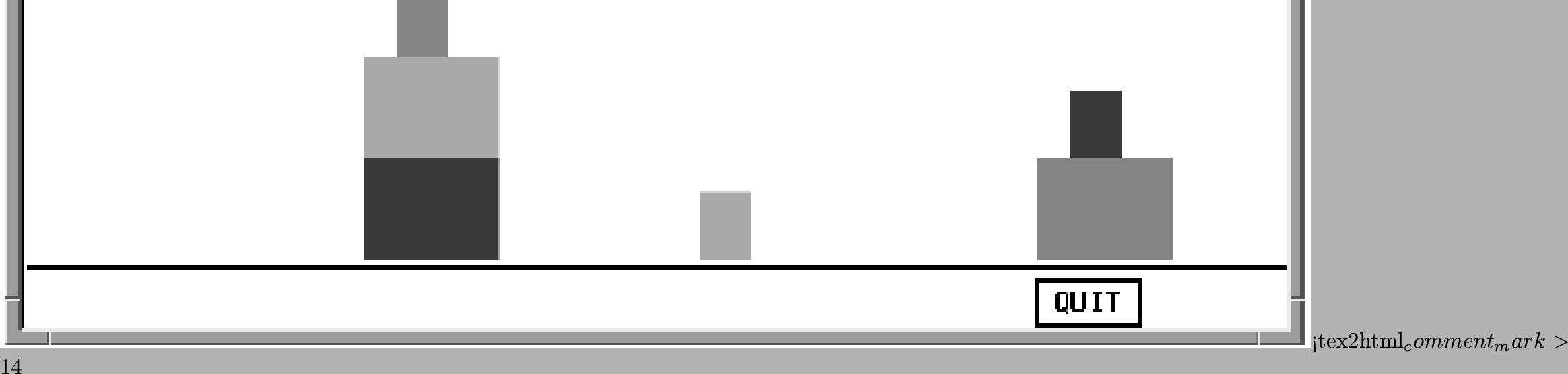
put a green block on a blue block
move the little red block onto a big green block
put a block on the table onto a blue block
put the block on a block on a block on a red block
is the big red block on the small green one
where is the small blue block
put it on the table
put the big green block on it
what is on the big green block
what is on the block on the big green one
FAILING TO COMMUNICATE
| Vocabulary |
put the tiny green block on the large blue block |
| Grammar (and vocabulary) |
put the small green block gently on the red
block |
| Ambiguity (parsing) |
put the block on a block on a block on a red block |
| Ambiguity (reference) |
put the block on a block |
| Semantics |
put the table on the small red blok |
| Semantics |
where is the table |
BLOCKS WORLD REPRESENTATIONS
- Vocabulary and grammar
- Layout and properties of blocks
- Effects of individual actions of ``hand''
Winograd, T. (1972)
Understanding Natural Language,
Academic Press, New York.
BLOCKS WORLD STAGES
- lexical and grammatical analysis
- extracting meaning(s)
-
- kind of sentence -- command/question
-
- specific content
- construction of pattern(s)
- match pattern onto world to get specific description
-
- for questions -- look up relationships
-
- for commands -- construct plan to achieve description
- report answer or carry out plan
GRAMMAR
[   [s [v np pp] [wh1 vbe np] [wh2 vbe pp]]
    [np [pn] [det snp] [det snp pp]]
    [snp [noun] [ap noun]]
    [ap [adj] [adj ap]]
    [pp [prep np]]
] -> blocks_grammar;
VOCABULARY
[   [noun   block box table one]
    [wh1    where]
    [wh2    what]
    [pn     it]
    [v      put move pickup putdown]
    [vbe    is]
    [adj    white red blue green big small large little]
    [prep   on onto to over in at under above by]
    [det    each every the a some]
] -> blocks_lexicon;
THE BLOCKS WORLD
[   [isa block objR] [colour red objR]   [size large objR]
    [isa block objr] [colour red objr]   [size small objr]
    [isa block objG] [colour green objG] [size large objG]
    [isa block objg] [colour green objg] [size small objg]
    [isa block objB] [colour blue objB]  [size large objB]
    [isa block objb] [colour blue objb]  [size small objb]
    [objb ison objG]
    [objG ison objR]
    [objR ison table]
    [objg ison table]
    [objr ison objB]
    [objB ison table]
] -> database;
WORDS INTO PATTERNS
where is the large red block

[s  [wh1 where]
    [vbe is]
    [np [det the]
        [snp [ap [adj large]
                 [ap [adj red]]]
             [noun block]]]]

[adj red]     means   [colour red ?x]          (adjrule)
[adj large]   means   [size large ?x]          (adjrule)
[noun block]  means   [isa block ?x]           (nounrule)

[where  [ [isa block ?x] [colour red ?x] [size large ?x] ] ]
RULES OF ACTION -- 1
[[   [operator pick up ?x]
    [preconditions [on_table ?x][clear ?x][empty hand]]
    [additions [holding ?x]]
    [deletions [on_table ?x][clear ?x][empty hand]]]
 [   [operator put down ?x]
    [preconditions [holding ?x]]
    [additions [on_table ?x][clear ?x][empty hand]]
    [deletions [holding ?x]]]
RULES OF ACTION -- 2
 [   [operator stack ?x on ?y]
    [preconditions [holding ?x][clear ?y]]
    [additions [on ?x ?y][clear ?x][empty hand]]
    [deletions [holding ?x][clear ?y]]]
 [   [operator unstack ?x from ?y]
    [preconditions [on ?x ?y][clear ?x][empty hand]]
    [additions [holding ?x][clear ?y]]
    [deletions [on ?x ?y][clear ?x][empty hand]]]
] -> operators;
CONCLUSIONS: MODELLING LANGUAGE
- Declarative symbolic representations
- Vocabulary and grammar
- Simple World: Layout and properties of blocks
- Changes in the simple world: Effects of individual actions of ``hand'':
declarative representations
- Interpreters for the representations
CONCLUSIONS: MODELLING LANGUAGE SCOPE
-
- Highly restricted notion of language
-
- limited vocabulary, grammar and possible meanings
-
- correct and complete sentences only
-
- limited sense of context
-
- no irony, poetry, socio-cultural analysis etc etc
-
- Non-symbolic approaches
-
- Non-grammaticality of everyday speech
-
- Statistical analysis of written and spoken corpora
-
- Speech I/O
Left: COGS Home Page
Up: COGS Home Page
Benedict du Boulay, Cognitive Modelling web pages updated on Sunday 5 May 2002